

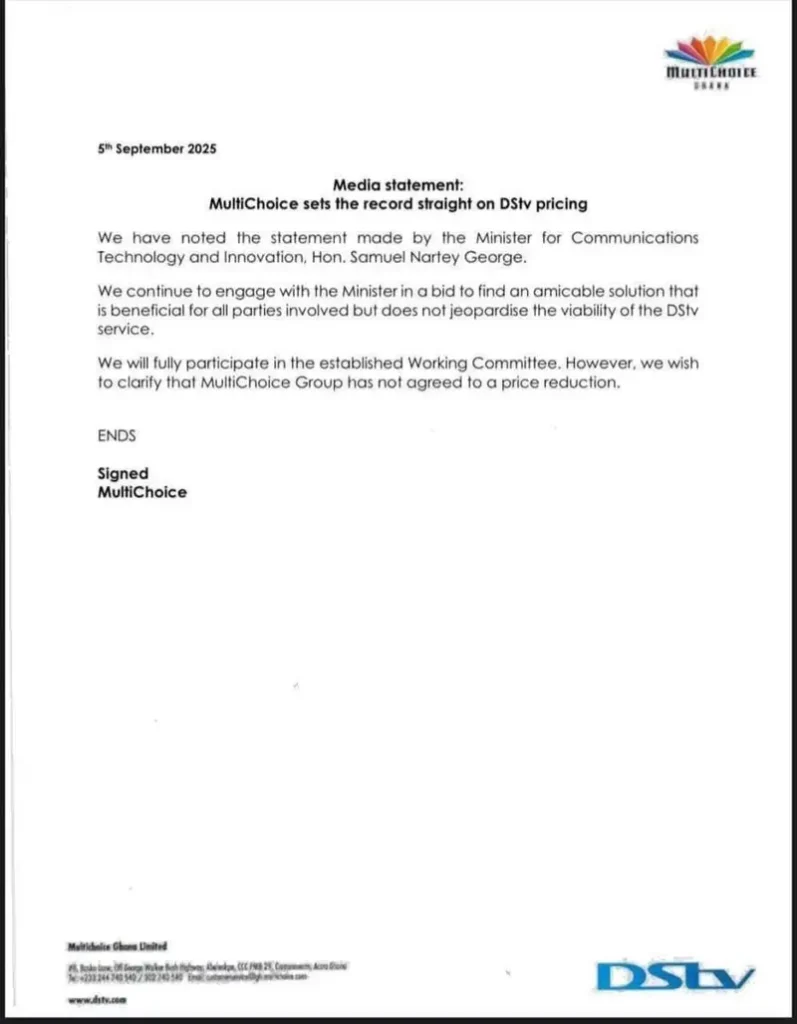
MultiChoice Ghana has publicly denied reports that it has agreed to lower DStv subscription fees, contradicting statements made by Minister of Communication, Digital Technology and Innovation, Sam George.
In a press release issued on Friday, September 5, the company emphasized its willingness to continue discussions with the government but clarified that no formal agreement on reducing prices has been reached. “We are committed to constructive engagement and will participate fully in the Working Committee. However, we must state clearly that MultiChoice Group has not agreed to any price reduction,” the statement read.
Earlier that same day, Minister Sam George had informed the media that MultiChoice had accepted the need for a price cut in principle, with the remaining task being to determine the extent of the reduction. He announced the formation of a committee—including representatives from the Ministry, the National Communications Authority (NCA), MultiChoice Ghana, and MultiChoice Africa—to finalize the pricing decision within 14 days, despite MultiChoice’s request for a 30-day timeline.
The disagreement stems from a months-long dispute over rising DStv fees. MultiChoice had previously increased its subscription rates, citing inflation, depreciation of the Ghanaian cedi, and escalating operational expenses. Some packages saw price hikes of nearly 20%, prompting widespread public backlash.
In response, the Ministry directed the company to slash its rates by 30%, a demand MultiChoice rejected, arguing it would compromise service quality and lead to job losses. Instead, the company proposed maintaining current prices and halting financial transfers to its parent firm in South Africa—a suggestion the Ministry declined.
On August 7, 2025, the NCA issued a formal notice under the Electronic Communications Act, warning MultiChoice to comply within 30 days or face suspension of its operating license. The company was also fined GHS 10,000 per day for failing to provide a detailed breakdown of its cost structure, with penalties exceeding GHS 150,000 by early September.
The ongoing dispute has sparked national debate, with some Ghanaians accusing MultiChoice of abusing its market dominance, while others view the situation as a test of the government’s commitment to consumer protection.

Author: Jasmine Adjei
Development journalist