
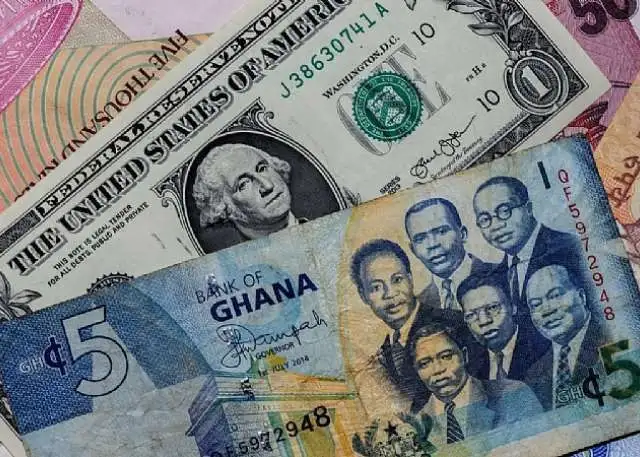
On Monday, September 1, the Cedi was buying at 11.3934 to a Dollar and selling at 11.4057, per the Bank of Ghana (BoG) rate.
This means the depreciation of the local currency against the major currencies continues.
The Pound is buying at 15.3914 and selling at 15.4080. The Euro buys at 13.3294 and sells at 13.3425.
On Friday, August 29, it was buying at 11.2444 to a Dollar and selling at 11.2556, per the rate from the Bank of Ghana (BoG) on Friday, August 29.
The Pound bought at 15.1956 and sold at 15.2120. The Euro also bought at 13.1291 and sold at 13.1410.
On Thursday, August 28, the Cedi was buying 11.0445 to a dollar and selling at 11.0555. The Pound was also buying at 14.8780 and selling at 14.8940. The Euro was buying at 12.8192 and selling at 12.8308.
The recent marginal depreciation of the Cedi raised concerns among the trading public.
This led to the Head of the Business and Economic Bureau of the Ghana Union of Traders’ Associations (GUTA) urging traders to remain calm.
The central bank has, however, taken steps to strengthen the Cedi.
The Bank of Ghana reiterated the caution to institutions and individuals against charging or accepting payments in foreign currencies for goods and services in Ghana, stressing that the Ghana cedi remains the only legal tender.
In a notice issued on Wednesday, August 27, 2025, the central bank reminded the public that under the Foreign Exchange Act, 2006 (Act 723), it is illegal for any person or institution without authorisation to engage in foreign exchange transactions.
These include black market dealings, pricing, invoicing or advertising in foreign currencies, particularly the United States dollar.
“The Ghana cedi remains the only legal tender in Ghana,” the notice signed by Mrs Aimee V. Quashie, Secretary to the Bank, said.
It added that no resident of Ghana, unless duly licensed or authorised by the Bank of Ghana, should price, advertise, invoice or receive payment in any foreign currency.
The directive covers transactions such as the payment of school fees, the sale and rental of vehicles, the sale and rental of real estate, airline tickets, domestic contracts, retail shopping, online sales and hotel accommodation.
According to the BoG, foreign currency invoices may be issued only to expatriates or non-residents, with proceeds required to be paid into a Foreign Exchange Account (FEA) with licensed banks.
The Bank further stated that exchange rates on such invoices must reflect prevailing market rates of commercial banks and be benchmarked against its published reference rate.
The Bank of Ghana said foreign exchange transfers for legitimate external payments remain permitted through the banking system, subject to regulatory limits and procedures.
It cautioned that enforcement would continue and warned that persons or institutions found to be in breach would face sanctions and prosecution in line with Act 723.