
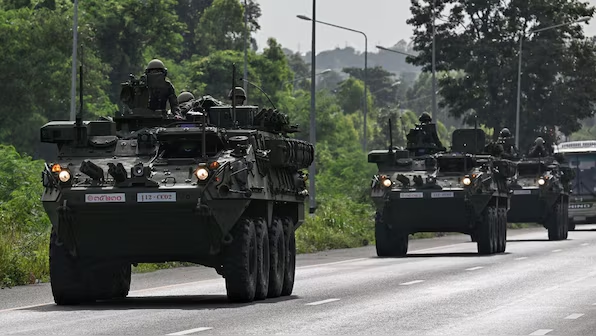
At least 12 people have been killed in a dramatic and deadly resurgence of conflict along the contentious Thai-Cambodian border, according to Thai officials. What began as a border patrol skirmish has rapidly spiraled into one of the most serious military confrontations between the two Southeast Asian neighbors in more than a decade—raising fears of a prolonged and destabilizing regional conflict.
The fighting broke out early Thursday, shaking the quiet frontier regions with the sounds of artillery and air strikes, and igniting panic among tens of thousands of civilians who were forced to flee their homes under immediate threat.
“The fighting is really serious. We’re in the middle of evacuating,” said Sutian Phiwchan, a resident of Ban Dan district in Thailand’s Buriram province, speaking to the BBC. His words reflect the gravity of a crisis that has gripped border communities in fear.
A Long-Festering Dispute Erupts Again
Though the latest violence is shocking in its intensity, the roots of this dispute run deep. The conflict is a manifestation of a century-old territorial disagreement stemming from colonial-era mapmaking and modern-day nationalism.
Tensions first came to the surface in their modern form in 2008, when Cambodia attempted to register the Preah Vihear Temple, a revered 11th-century Khmer-Hindu site located in the disputed border area, as a UNESCO World Heritage Site. The move triggered outrage in Thailand, which claims the land surrounding the temple as its own. Although the International Court of Justice (ICJ) had ruled in 1962 that the temple itself belonged to Cambodia, ownership of the surrounding 4.6 square kilometers remained hotly contested.
Since then, sporadic armed clashes have occurred—claiming the lives of both soldiers and civilians. But Thursday’s events mark a dangerous escalation, with full-scale military exchanges and diplomatic fallout reverberating across the region.
Conflicting Narratives, Growing Danger
Each side offers a starkly different account of how the recent violence began.
Thailand accuses Cambodia of initiating hostilities by deploying unmanned surveillance drones over Thai territory near the border. According to Bangkok, these drone flights violated Thai airspace and raised suspicions of a potential preemptive strike by Cambodian forces.
Cambodia, however, tells a different story—claiming that it was Thai forces who breached a long-standing bilateral agreement by advancing on the disputed territory near the Preah Vihear temple. Cambodian officials say Thai troops crossed a red line, triggering a defensive response.
The situation escalated quickly. Thailand reported that Cambodia launched rocket attacks, while Thai forces retaliated with air strikes on what they identified as Cambodian military installations. The exchange of heavy artillery created chaos on both sides of the border and drew condemnation from international observers who have urged restraint.
Casualties Mount, Civilians Suffer
Thai military authorities confirmed that 12 people were killed—11 of them civilians, including children aged 8 and 15. One soldier also lost his life during the initial clashes. The casualties occurred in three Thai provinces: Surin, Ubon Ratchathani, and Srisaket—all of which border Cambodia.
While Cambodia has not publicly confirmed its own casualty figures, the scale of the fighting suggests losses may be significant on both sides. Reports from local media in Phnom Penh suggest military hospitals have received dozens of wounded soldiers, though official statements remain sparse.
In response to the escalating violence, the Thai government has closed all official border crossings with Cambodia and begun evacuating civilians from vulnerable regions—more than 40,000 people have already been moved to safer areas, according to Thai authorities.
Cambodia has retaliated by downgrading diplomatic ties with Thailand and accusing the Thai military of using “excessive force” in its response—particularly for deploying airpower in what Cambodia insists should be a demilitarized zone.
An Economic and Diplomatic Fallout
Beyond the battlefield, the conflict has already begun to take a toll on diplomatic and economic relations. In the past two months alone, both countries have imposed economic restrictions against each other.
Cambodia has halted the import of Thai agricultural products—particularly fruits and vegetables—and has also suspended the reception of Thai-generated electricity and internet services, which parts of rural Cambodia depend on.
Thailand, for its part, has limited cross-border trade and reinforced troop deployments along the length of its eastern border. Both nations have visibly ramped up their military presence, fueling fears of a wider confrontation that could drag on for weeks or even months.
International Community Urged to Step In
Regional bodies such as the Association of Southeast Asian Nations (ASEAN) have so far remained cautious in their response. Diplomats from several member states have called for calm and offered to mediate, but no formal ceasefire negotiations have yet materialized.
Analysts warn that the situation could deteriorate rapidly if cooler heads do not prevail.
“This isn’t just about an ancient temple anymore,” said Dr. Pichai Wiraseth, a Southeast Asian geopolitics expert. “What we’re seeing is nationalism, unresolved history, and geopolitical rivalry clashing all at once. If diplomacy fails, this could become a broader regional crisis.”
A Dangerous Precedent
The ongoing conflict serves as a painful reminder of how unresolved historical disputes can ignite into modern-day warfare—particularly in regions where borders were drawn by colonial powers without regard to ethnic, cultural, or geographical realities.
With civilian lives already lost, border towns emptied, and bilateral ties at their lowest point in over a decade, Thailand and Cambodia now face a critical choice: escalate further, or return to the negotiating table.
Until then, the guns roar on—and the shadow of war looms large over Southeast Asia.
SOURCE : BBC
Edited by: KENNEDY NTI AMPONSAH
EASTERN FM 105.1 MHZ