

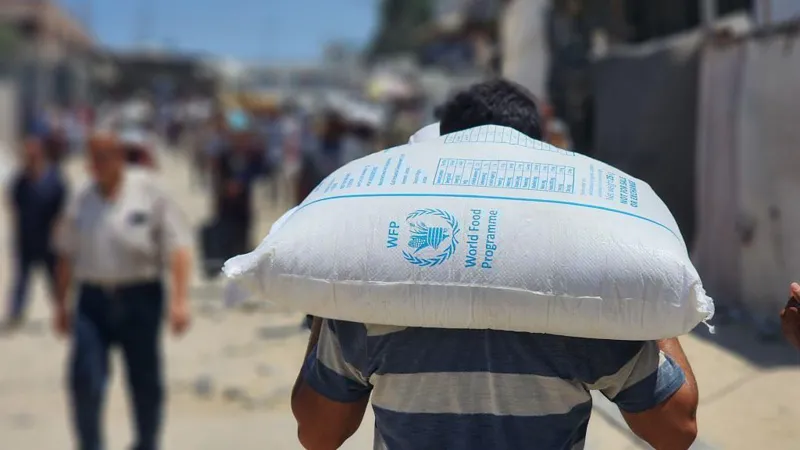
BBC News and three of the world’s most prominent news agencies—Agence France-Presse (AFP), Associated Press (AP), and Reuters—have issued an urgent joint statement expressing deep concern for the safety and wellbeing of local journalists in Gaza. These journalists, they report, are increasingly unable to access basic necessities, including food, and are now facing the very same life-threatening conditions they have been documenting for months.
The stark warning comes amid a broader humanitarian catastrophe unfolding in Gaza, where international aid organizations and human rights groups continue to warn of imminent mass starvation among the population. Journalists, many of whom are the only remaining eyes and ears of the world inside the sealed-off territory, are now personally suffering from the same deprivation and desperation that has gripped the wider civilian population.
“For many months, these independent journalists have been the world’s eyes and ears on the ground in Gaza,” the joint statement reads. “They are now facing the same dire circumstances as those they are covering.”
These local reporters, often freelancers or contributors to international outlets, have played a vital role in ensuring the global community remains informed about the realities on the ground. Since foreign media have been barred from entering Gaza by Israeli authorities—including journalists from BBC News and other major networks—these local voices have become the only conduit for verified reporting in the besieged enclave.
The news organizations emphasized that while journalists often accept considerable personal risk when reporting from war zones, the current situation has crossed into an unprecedented realm. “Journalists endure many deprivations and hardships in warzones. We are deeply alarmed that the threat of starvation is now one of them,” the statement declared.
The joint plea also renewed calls for Israel to allow the entry and exit of journalists from Gaza and to facilitate the unimpeded delivery of food and humanitarian aid into the territory. “It is essential that adequate food supplies reach the people there,” the statement urged.
Humanitarian Groups Echo the Call: ‘People Are Wasting Away’
In a parallel statement, leading international NGOs including Médecins Sans Frontières (MSF), Save the Children, and Oxfam voiced similar concerns. They described the humanitarian collapse as catastrophic, noting that both aid workers and the civilians they support are “wasting away” due to prolonged food insecurity and the near-complete collapse of medical services.
The NGOs condemned the continued obstruction of aid deliveries and highlighted that thousands are at risk of death due to malnutrition and preventable diseases. Their warning paints a grim picture of daily survival in Gaza, where bread, clean water, and basic medical supplies have become nearly unattainable luxuries.
Israeli Response and the Blockade’s Impact
Israel, which maintains control over most of the entry points into Gaza, responded by accusing the humanitarian organizations of “serving the propaganda of Hamas,” the militant group that governs Gaza. Nevertheless, mounting evidence, including independent assessments from global bodies, suggests that the humanitarian toll is accelerating.
Since Sunday alone, at least 45 Palestinians have reportedly died from malnutrition, according to figures released by Gaza’s health ministry, which is run by Hamas. These numbers add to an already staggering toll caused by war, displacement, and siege.
Following the end of a temporary ceasefire earlier this year, Israel tightened its blockade of Gaza in early March, severely restricting the flow of goods, including humanitarian aid. Although some of these restrictions were later eased after nearly two months, aid organizations say the current level of access is far from sufficient to meet the scale of the crisis.
The Controversial Gaza Humanitarian Foundation
In an attempt to address growing international pressure, Israel—working alongside the United States—helped to launch a new aid mechanism known as the Gaza Humanitarian Foundation (GHF). However, the system has drawn widespread criticism from human rights observers and aid groups, who argue that it has not effectively improved the delivery of assistance and has instead created new security risks.
Since the GHF began operating eight weeks ago, reports have emerged of violence and chaos surrounding its aid distribution centers. Hundreds of people have been reportedly killed near these sites, raising questions about the system’s ability to safely and equitably deliver aid.
Famine Looms: A Man-Made Disaster
The World Health Organization (WHO) has issued its own stark warnings, estimating that one in four people in Gaza are now enduring famine-like conditions. According to the agency, the crisis is no longer a looming threat but a current and escalating reality.
In a powerful statement on Wednesday, WHO Director-General Dr. Tedros Adhanom Ghebreyesus said: “I don’t know what you would call it other than mass starvation, and it’s man-made. And that’s very clear—this is because of the blockade.”
Dr. Tedros’s remarks reflect the growing international consensus that the starvation crisis in Gaza is not the result of natural disaster or logistical failure, but a direct consequence of political and military decisions. The deliberate restriction of aid access and the continued bombardment of critical infrastructure have left the population cornered in a humanitarian dead zone.
Edited by: KENNEDY AMPONSAH NTI
EASTERN FM 105.1 MHZ